

 Deutschland | €
 United Kingdom | £
 Italy | €
 Polska | zł
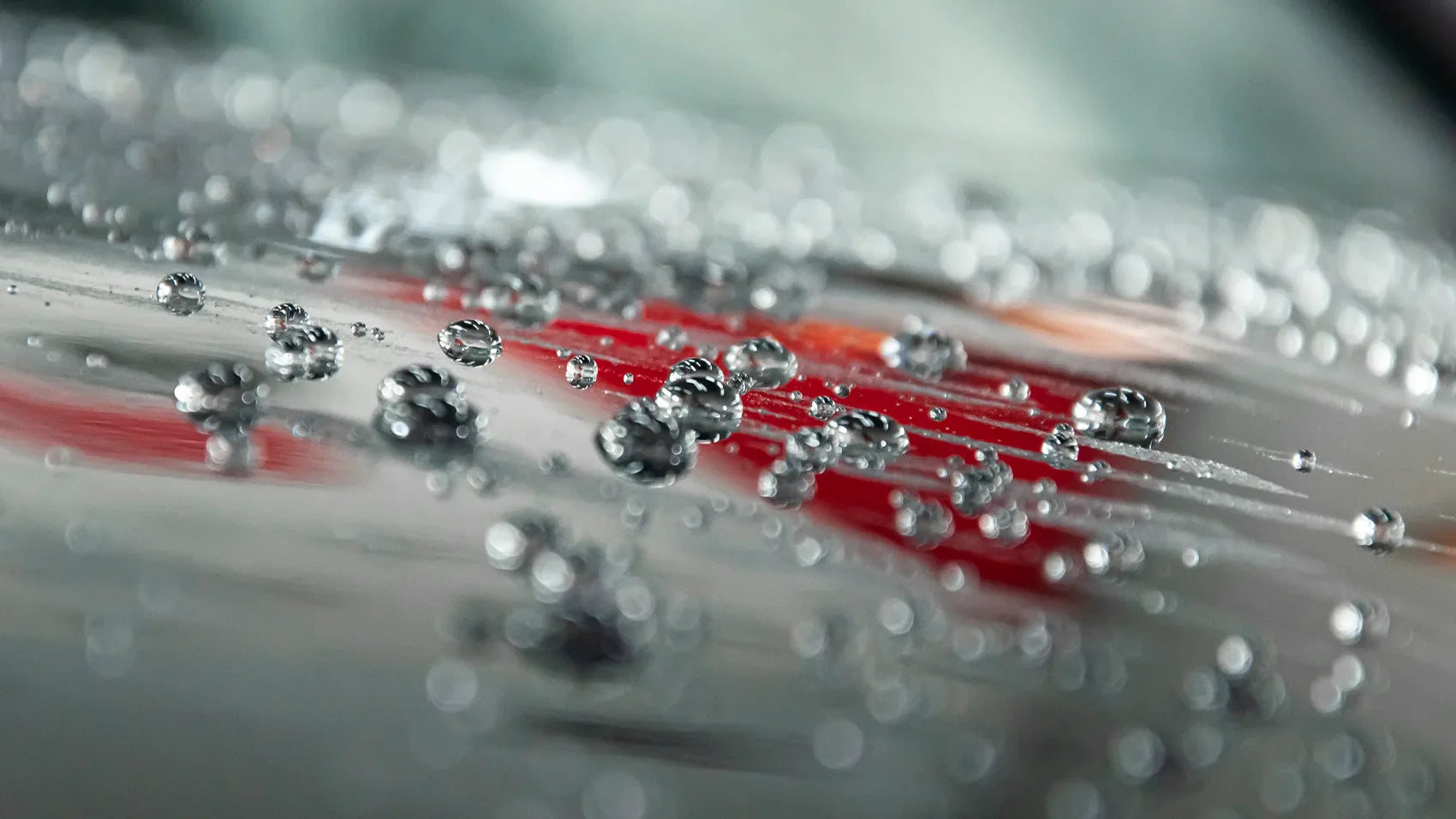
Have you ever noticed those small, perfectly round water droplets forming on a vehicle after waxing or applying a coating? These little beads are more than just a visual treat that detailers love. On paintwork, water beading is a sign of excellent protection against dirt and environmental factors, while on glass it indicates improved driving safety and comfort.
In the detailing community, water repellency seems to be yet another topic of endless debate. Let's first find out how to achieve hydrophobic performance in the first place, explore the difference between the types of water behaviour on a protected vehicle, and understand the common issues associated with it – along with tips on how to resolve them.
Why is it good when a car repels water?
Why should you care whether your car repels water? Because a hydrophobic finish is a protected finish!
By repelling rain, the paintwork, glass and other parts of the car are shielded from the most common environmental contaminants, such as acid rain, metallic particles from brake dust, and carbon-based particles from exhaust fumes. This in turn makes everyday maintenance easier and, in the long run, helps preserve the vehicle's value and appearance.

Hydrophobic glass takes car care to a whole new level. With a clean, well-protected windscreen you can see more and react faster to events unfolding ahead of you while driving, which increases road safety – especially after dark. It's precisely the performance of Glaco coatings that forms the basis of our Drive Safe campaign, making us the first in the detailing industry to highlight the positive impact of glass coatings on road safety.
With that in mind, here are the 3 key aspects of hydrophobic car care we'd like to highlight:
Waxes
The most advanced car waxes, such as our Fusso Coat 12 Months, offer up to 12 months of paint protection – particularly useful during the challenging autumn-winter-spring period, when proper and regular car maintenance becomes more difficult. There's of course a wide range of other waxes available, each offering different end results. And when it comes to water beading, nothing comes close to Soft99's Water Block Super Splash – a genuine Japanese marvel in terms of water repellency.
Coatings
Although significantly more demanding to apply than waxes, ceramic coatings provide far longer-lasting protection. Coatings such as QJUTSU Universal or the professional favourite QJUTSU Body Coat Pro form a durable, glass-like bond with the paintwork and deliver strong hydrophobic performance for months or even years – making them ideal for those who want long-term protection with minimal upkeep.
Glaco glass coatings
Specially engineered to deliver the best possible visibility, glass coatings such as Japan-made Glaco products can provide up to 12 months of windscreen protection. Particularly useful during autumn and winter rains, glass coatings are not only a money-saving solution, but also a genuine road safety measure.

With a deeply cleaned windscreen protected by a Glaco coating, you'll certainly enjoy a noticeable improvement in driving comfort. But the story doesn't end there. With coatings such as Glaco Mirror Coat Zero, you can experience ultra-hydrophobic performance – an exceptionally strong water-repelling effect – on your door mirrors and dashcams too.
Beading or sheeting?
Hydrophobic properties on cars take two forms: water beading (a hydrophobic, water-repelling effect) and water sheeting (a hydrophilic, water-shedding effect).
Water beading occurs when water forms small, spherical droplets on a surface. Beading is a visual sign that the car's protective layer is working, and is often considered highly attractive by car enthusiasts and detailers – especially when the contact angle of the droplet (an important term for hydrophobic performance fans!) is high. The higher the angle, the better and stronger the protection. There is, however, another distinct type of water behaviour.
Water sheeting occurs when water runs off the surface in a flat, uniform wave rather than forming droplets. This is beautifully illustrated in the video showcasing G'zox – a Soft99 brand – and its Real Glass Coat Class H (from 2:02).
Although it may not look as impressive as beading, sheeting helps reduce the amount of water remaining on the surface, which can help prevent a common consequence of beading: water spots. Both sheeting and beading indicate that the vehicle has been protected against the elements in some way, but sheeting is typically achieved through more advanced ceramic coatings or spray coatings.
Common water beading problems
In the world of car care, no solution is perfect, and even the most enthusiastic beading fans will have to admit: not everything that beads is beautiful.
Water spots
While beading is a great sign of protection on paintwork or glass, it can sometimes lead to the formation of water spots. When beads dry on the surface, they can leave behind mineral deposits or contaminants which, depending on their severity, can take the form of soft or hard water spots. Here's how to prevent them and how to deal with them:
Wash or rinse your car regularly
After rain or a particularly "dirty" journey, take your vehicle to a contactless car wash. Reverse osmosis (RO) water, commonly used in car washes, leaves no deposits on the car and can remove some soft water spots in most wash cycles for a modest cost.
Use a car care product
If lighter solutions fall short, you can use specialist products to gently dissolve mineral deposits without damaging the car's protective layer. If the contamination isn't too severe, waterless quick detailers such as Fukupika Spray, combined with a microfibre towel, can work wonders on many types of water spots on car paintwork.
Stain Cleaner is also an excellent choice for this purpose – beyond water spots, it'll tackle dried insect residue, bird droppings, dried tree sap and any other external contaminants that tend to find their way onto a car kept outdoors.
Paint correction
If stubborn, hard water spots prove too difficult to remove using conventional means, paint correction is probably worth considering.
Summary
Is your car beading water? Brilliant! It's a sure sign that the owner is taking good care of their vehicle. Whether you're achieving that effect on the paintwork through waxes or ceramic coatings, or on the glass through Glaco, what matters is regularly refreshing your protective layer and addressing common issues such as water spots at an early stage – before they become a headache.